News, commentary and industry thinking from the Granite Solutions team
Industry insights
Stay up to date with the latest thinking from Granite Solutions on the UK electrical industry, data centre growth, net zero targets, and critical national infrastructure.
AI Data Centres: Britain's Next Economic Powerhouse?
Fear, risk, environmental impact. When people talk about AI and the hyperscale data centres that host it, these are the narratives that dominate. But is that the only story? The key themes below offer a balanced view of what this new sector could mean for the UK.
1. Unlock near-term productivity gains
Prioritise AI deployment in financial services, life sciences, advanced manufacturing, professional services and public administration, with practical adoption support for SMEs.
UK economic deliverables now: faster business processes, lower operating costs, improved public-service efficiency, increased private investment, and new demand for UK cloud, cybersecurity, engineering and maintenance providers.
2. Build power and grid capacity
Accelerate connections for strategically located data centres alongside renewable generation, storage, network reinforcement and efficient cooling.
UK economic deliverables now: a funded pipeline of grid upgrades, faster connection decisions, additional clean-power capacity, reduced curtailment, heat-reuse pilots, and investable projects for British energy, construction and engineering firms.
3. Convert skills and trust into jobs
Expand short-cycle AI training, apprenticeships and conversion programmes while setting clear standards for safety, privacy and accountability.
UK economic deliverables now: a larger job-ready workforce, quicker recruitment into technical roles, stronger public confidence, broader AI adoption by employers, and a competitive UK market for assurance, compliance and responsible-AI services.
4. Secure regional investment and domestic capability
Designate investable AI and data-centre clusters around available power, fibre, land, universities and engineering talent, including Scottish locations.
UK economic deliverables now: faster project decisions, skilled jobs beyond London and the South East, contracts for local suppliers, stronger university-industry partnerships, growth of UK scale-ups, and more intellectual property, tax revenue and strategic computing capacity retained in the country.
5. Speed up planning while locking in local value
Establish clear national planning criteria, coordinated consent timetables and standard community-benefit expectations for major data-centre projects.
UK economic deliverables now: reduced delays and investor uncertainty, construction and permanent technical jobs, apprenticeships, local procurement, business-rate income, infrastructure improvements, and transparent commitments on energy, water, noise, land use and environmental protection.
What's next for London's data centre market?
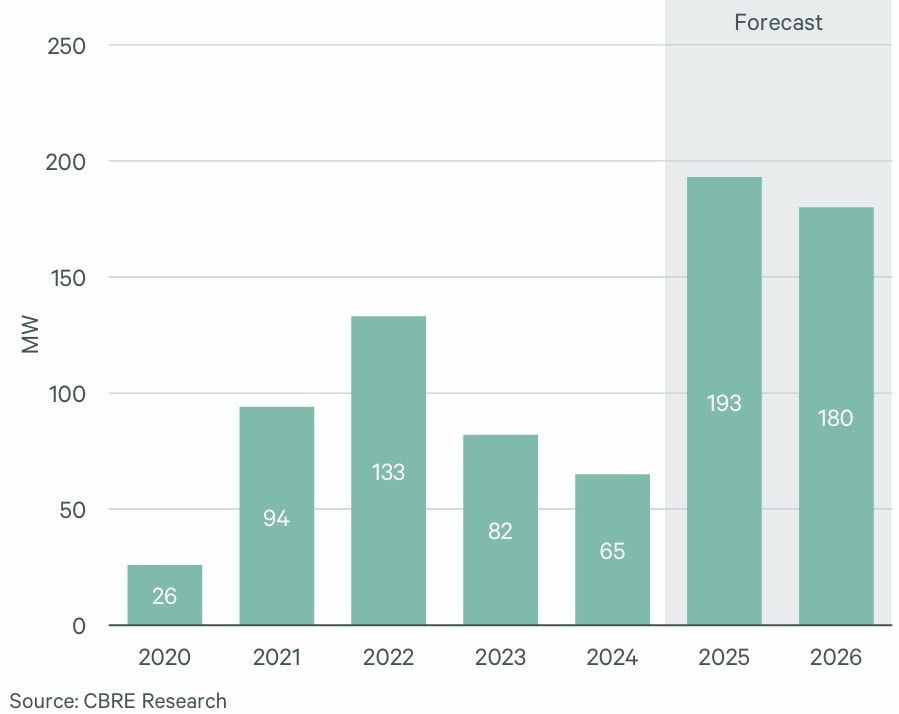
2026 is forecast to deliver 180MW of new data centre supply — the second-highest year on record. With London take-up expected to reach 189MW and vacancy at a record-low 5.9%, demand continues to outpace supply for a fifth consecutive year.
2026 Trends for data centres
2026 is forecast to deliver 180MW of new data centre supply, the second-highest year on record and just below the 2025 peak.
London take-up is expected to reach 189MW in 2026, exceeding new supply for a fifth year and pushing vacancy to a record-low 5.9%.
Neocloud demand is rising as hyperscalers seek quick access to compute capacity near London.
London's data centre market will keep expanding beyond Slough and Hayes/Park Royal into power-rich areas such as North London, Oxfordshire, Hertfordshire, Docklands and Essex.
UK AI growth zones, including Culham, Teesside, Newcastle and Wales, aim to support up to 500MW of data centre capacity per zone.
2027 Trends for data centres
2027 is forecast to be delivering around 180–200MW+ of new supply.
Why this matters: demand is running ahead of supply as hyperscalers, AI workloads and neoclouds race for compute capacity close to London. With vacancy at record lows, more capacity is critical to stop growth being held back by shortages, power constraints and limited space in core London clusters.
UK upside: more capacity means faster AI adoption, stronger cloud resilience, new regional investment and more skilled jobs. It also strengthens the UK's position as a leading European tech hub, attracting global cloud, AI and digital infrastructure investment.
Beyond 2027: Growth likely shifts toward AI zones and power-rich locations outside core London.
Overall: continued capacity growth, tight supply, low vacancy and wider geographic expansion.
Source – CBRE Research
Is UK Net Zero Aviation possible?
The UK has ambitious net zero targets, but aviation remains one of the hardest sectors to decarbonise. We look at the challenges and what the electrical infrastructure industry needs to deliver.
Why are data centres a positive opportunity for the UK?
Data centre investment is accelerating across the UK. We explore why this represents a significant opportunity for the electrical contracting sector and the wider economy.
Is the UK ready for data centre growth with the Gulf Arab States?
Gulf sovereign wealth funds are increasingly investing in UK data centre infrastructure. We consider whether the UK grid and electrical supply chain is ready to meet the demand.
Is the UK Next for Quantum Computers in Data Centres?
Quantum computing is moving from the lab to commercial data centres. What does this mean for power requirements and the electrical infrastructure needed to support it?
Are Hyperscalers safe with the Critical National Infrastructure?
As hyperscale data centres become embedded in the UK's digital economy, questions are being asked about their role within critical national infrastructure and the risks that brings.
Data centres hit first with water rationing in UK drought?
Data centres rely heavily on water for cooling. In a prolonged UK drought, could they be first in line for rationing — and what are the implications for power and operations?
What happens when delays occur in UK data centre builds?
Grid connection delays and supply chain pressures are causing significant hold-ups in UK data centre construction. We look at the knock-on effects and how contractors can respond.
Want to work with us?
Get in touch with our team to discuss your next electrical project.